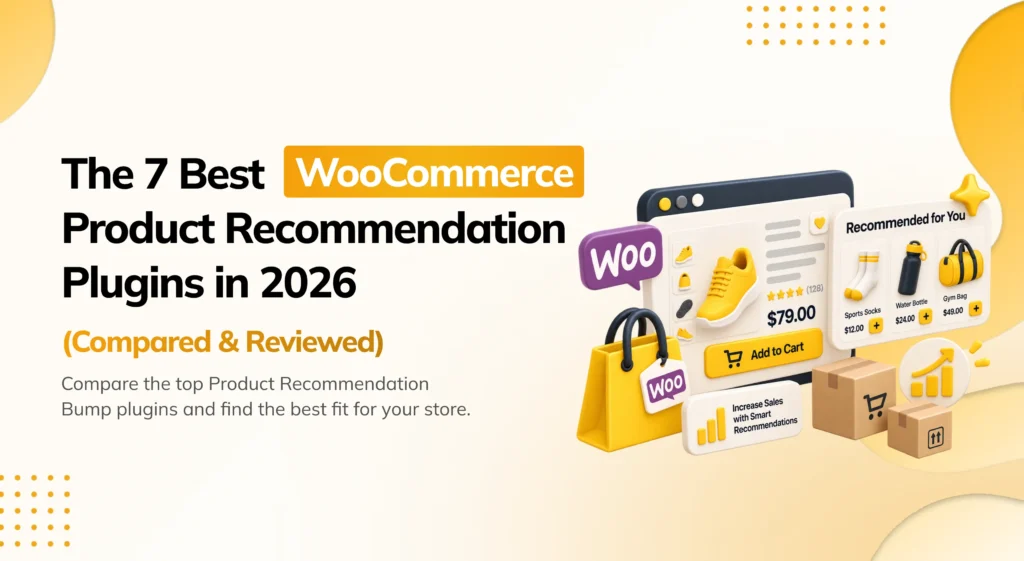
A customer scrolls through a backpack listing. They never think to check whether there’s a matching rain cover, a set of packing cubes, or a spare water bottle holder, not because they wouldn’t want them, but because nothing on the page suggested it. This is exactly the gap a WooCommerce product recommendation plugin is built to close.
WooCommerce comes with very little built in for this. There is a basic “Related Products” section that pulls items from the same category, and a manual “Upsells” and “Cross-sells” field on the product edit screen. Neither one is a genuine recommendation engine. If you want recommendations that are actually based on what customers tend to buy together, that show up in the cart and at checkout, and that you can target to specific visitors, you need a dedicated plugin.
There are now many WooCommerce product recommendation plugins on the market, and they solve the problem in different ways. Some plugins recommend products automatically, using order history to work out what’s frequently bought together. Others rely on you choosing the recommendations by hand, which gives more control but takes more setup time. Picking a plugin just because it promises “AI-powered recommendations” often leads to the wrong fit. The better question is: where do you want the recommendation to appear, and how much control do you need over what gets shown?
This guide looks at each plugin one by one. It explains what each one does, how the recommendations are generated, what they cost, and where they fall short. By the end, you should be able to match a plugin to your store, not just install the most familiar name.
How I Evaluated These Plugins
Before the list, it helps to explain how these plugins were judged. A long feature list does not tell the whole story. A plugin can promise smart recommendations and still show something irrelevant, because the underlying logic is too generic for your catalog.
Each plugin was reviewed from the point of view of a WooCommerce store owner. How easy is it to get your first recommendation live? Does the plugin generate suggestions automatically, or do you have to pick everything by hand? Are the recommendations shown somewhere a customer will actually notice? Does it feel stable enough to trust on a live store, where a bad recommendation can make the page look cluttered rather than helpful?
Before you install any recommendation plugin, back up your store first. Recommendation plugins connect directly to your product pages, cart, and sometimes checkout. A recent backup matters more here than with most other plugin types.
Here are the main things this comparison looked at:
- Recommendation coverage — Does it show suggestions on the product page, cart, checkout, and post-purchase? Or does it only do one of these?
- How recommendations are generated — Automatically, from order history, manually by hand, or both?
- Targeting and rules — Can recommendations be shown only to certain visitors, based on product, category, cart total, or customer type?
- Checkout compatibility — Does it work with both the classic WooCommerce checkout and the newer Cart and Checkout Blocks?
- Pricing and free plan — Is the free version actually useful? Or is it just a demo meant to push you toward paying?
The Best WooCommerce Product Recommendation Plugins
| Plugin | Pricing | Best For |
|---|---|---|
| PickPair | Freemium (paid plans on request) | Recommendations across the whole customer journey, from one plugin |
| WooCommerce Product Recommendations | Premium (official WooCommerce.com extension) | Stores that want an official WooCommerce.com extension |
| YITH WooCommerce Frequently Bought Together | Freemium (paid license, check pricing) | Simple product-page bundles only |
| Personalized Recommendations (StoreApps) | Premium (from $149/yr) | Advanced, rule-based recommendation logic |
| FunnelKit | Freemium (from $99.50/yr) | Recommendations plus email automation |
| UpsellWP | Freemium (Pro from $69/yr) | Best free recommendation plugin to start with |
| CartFlows | Freemium (check official pricing) | Rebuilding checkout around recommendation offers |
1. PickPair — Best All-in-One WooCommerce Product Recommendation Plugin
PickPair works well for store owners who want product recommendations on the product page, in the cart, at checkout, and after purchase, all from one plugin. If you want a single dashboard instead of four different tools to cover the whole buying journey, start here.
PickPair’s main idea is simple: show the right recommendation at the right moment, everywhere a customer might need one. On the product page, it shows an Amazon-style “Frequently Bought Together” box, where customers tick the items they want and add them all to the cart in one click, often with a bundle discount. In the cart, it recommends related products and shows a free shipping progress bar. At checkout, recommended add-ons appear as order bumps with a single checkbox. After the sale, a Thank You page offer recommends one more relevant product, and an automatic next-order coupon brings the customer back to shop again later.

The recommendations are not shown to everyone the same way. Smart Rules let you target by product, category, cart total, customer type, login status, or past orders, so a first-time visitor and a returning customer don’t see the exact same suggestion. You can also choose which products should be recommended together by hand, instead of relying only on automatic logic. PickPair works with both the classic WooCommerce checkout and the newer Cart and Checkout Blocks, and every recommendation has its own report showing views, clicks, and revenue.
Key features:
- Frequently Bought Together bundles on the product page, with percentage, fixed-amount, or flat-price discounts.
- Cart recommendations and a free shipping progress bar.
- Checkout order bumps added with a single checkbox.
- Add-to-cart pop-up recommendation.
- Post-purchase Thank You page offers.
- Automatic next-order coupon to bring customers back.
- Manual or rule-based product selection for recommendations.
- Smart Rules based on product, category, cart total, customer type, login status, and order history.
- Works with both the classic checkout and the Cart and Checkout Blocks.
- Built-in reporting for each recommendation, so you don’t need a separate analytics tool.
Pros:
- Covers five different recommendation locations from one plugin.
- Free plan is genuinely useful, not just a locked demo.
- Smart Rules stop the same recommendation being shown to every visitor.
- Built-in reports mean you don’t need another tool for analytics.
- Works well with WooCommerce’s newer block-based checkout.
Cons:
- Newer to the market, so it does not yet have years of reviews like some older plugins.
- Fewer third-party guides and community discussions than more established tools.
- Paid plan pricing is not listed publicly; you need to check with the plugin’s own website for a quote.
Pricing: A free plan is available. Paid plans exist for stores that need higher limits or more advanced targeting. Check the official PickPair website for current pricing.
Final verdict: PickPair is a strong pick if you don’t want to manage several plugins just to show relevant recommendations across your store. Covering the product page, cart, checkout, and post-purchase stage from one dashboard, with shared rules and one set of reports, is its main advantage over using several smaller plugins together.
2. WooCommerce Product Recommendations — Official Recommendation Extension
WooCommerce Product Recommendations works well for stores that specifically want an extension built and maintained by WooCommerce.com itself. If sticking to official, first-party tools is a priority for your store, this is the safest name on this list.
This extension shows “customers also bought,” “you may also like,” and “frequently bought together” style recommendations across the product page, cart, and checkout, using WooCommerce’s own order data to decide what to suggest automatically. Because it is built directly by the WooCommerce.com team, it tends to stay closely in step with core WooCommerce updates, and it also supports manual recommendation blocks that you set by hand.
Key features:
- Automated “customers also bought” and “frequently bought together” recommendations.
- Manual recommendation blocks you can set by hand.
- Placement on the product page, cart, and checkout.
- Built on native WooCommerce order data.
Pros:
- Built and maintained by the official WooCommerce.com team.
- Tends to stay well aligned with core WooCommerce updates.
- Automated recommendations need little manual setup.
Cons:
- No free version.
- Less flexible targeting than dedicated rule-based recommendation plugins.
- Fewer offer types (no post-purchase upsell or loyalty coupon features).
Pricing: No free version. Sold as a yearly subscription through the official WooCommerce Extensions store; check WooCommerce.com for current pricing.
Final verdict: Worth it if you specifically want an official, first-party extension and don’t need advanced targeting or post-purchase offers. For deeper rules or a fuller recommendation journey, a dedicated plugin goes further.
3. YITH WooCommerce Frequently Bought Together — Product Page Recommendations
YITH’s plugin works well for stores that only need product-page recommendations, without cart, checkout, or post-purchase features. If an Amazon-style “frequently bought together” box is the only kind of recommendation you need, this is the most focused option available.
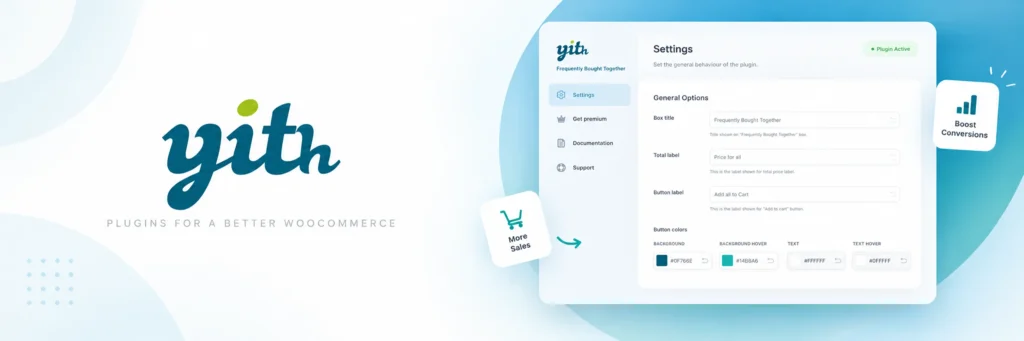
YITH’s plugin does one job, and it does that job simply. It shows a “frequently bought together” box on the product page, with a set of suggested items chosen by hand. Customers can add the whole group to their cart with one click, often at a bundle discount. It does not touch the cart page, checkout, or post-purchase steps at all.
Key features:
- Frequently Bought Together box on the product page.
- Manual choice of which products are recommended together.
- Optional bundle discount.
- Choice of where the box appears on the product page.
Pros:
- Its narrow focus means a shorter learning curve than a full-journey plugin.
- A long-established plugin with years of real use behind it.
- Simple to use for stores that only need this one feature.
Cons:
- Does not cover cart, checkout, or post-purchase recommendations at all.
- The free version is fairly limited; most settings need the paid license.
- No automatic, order-history-based recommendation logic.
Pricing: A free version is available on WordPress.org with limited settings. A paid premium license unlocks more customization; check current pricing on the official YITH website.
Final verdict: If a simple product-page recommendation box is genuinely all you need, YITH’s narrow focus is a strength, not a weakness. For anything beyond the product page, you will need to pair it with another plugin.
4. Personalized Recommendations by StoreApps — Advanced Rule-Based Recommendations
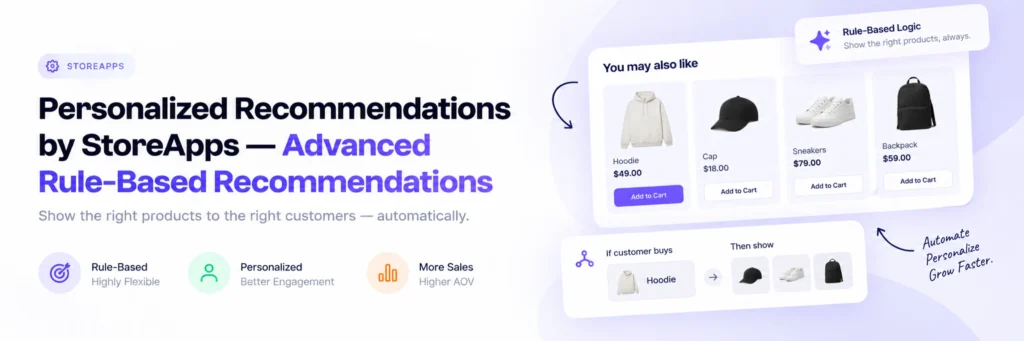
Personalized Recommendations works well for stores that want recommendation logic too complex for a simple “related products” box. If your store needs conditional rules and recommendations that change based on customer behavior, this plugin is built for that.
Built by StoreApps, this plugin supports cart recommendations, checkout suggestions, one-click post-purchase upsells, BOGO (buy one get one) deals, and product bundles. All of these can be controlled with AND/OR rules based on product, variation, quantity, category, cart total, attribute, or user role. Its standout feature is sequencing. This means a recommendation can lead to a different follow-up offer, depending on whether the customer accepts or declines the first one. A customer buying a coffee grinder might see a cart recommendation for a bag of beans; if they decline it, they could be shown a simpler bundle instead.
Key features:
- Cart and checkout recommendation offers.
- One-click post-purchase upsells.
- BOGO offers and product bundles.
- AND/OR targeting rules based on product, category, cart total, attribute, and user role.
- Sequenced offers that change based on accept or decline behavior.
Pros:
- The deepest targeting and rules engine of any plugin in this guide.
- Offer sequencing is not offered by any other plugin here.
- Handles complex, conditional recommendation logic well.
Cons:
- No free version, so you cannot test the rules engine before paying.
- Setup takes longer than plugins built around simpler, single offers.
- More plugin than you need if your targeting needs are simple.
Pricing: No free version. Starts at around $149 per year for one site.
Final verdict: Personalized Recommendations is worth the price when your recommendation logic is genuinely complex. If you just want “show related products on every order,” a simpler, cheaper plugin will get you there faster.
5. FunnelKit — WooCommerce Recommendation Plugin with Email Automation
FunnelKit works well for stores that want checkout recommendations and order bumps along with built-in email marketing automation. If checkout improvements and post-purchase email sequences are both on your list, this plugin covers both.
FunnelKit, formerly WooFunnels, is really two tools joined together. One part handles checkout order bumps and one-click post-purchase upsells, letting you set rules based on cart contents or customer behavior. The other part is a CRM and email automation system called FunnelKit Automations, handling things like abandoned cart recovery and win-back emails, the kind of work you would otherwise need a separate email tool for.

This combination is the main reason to choose FunnelKit over a smaller recommendation plugin. If email marketing is already something you plan to set up, getting it and your product recommendations from one company means fewer tools to manage.
Key features:
- Checkout order bumps with rules based on cart contents and customer behavior.
- Several recommendation offers on the same checkout page.
- One-click post-purchase upsells and downsells.
- A/B testing for offer wording and design, on higher-priced plans.
- Built-in CRM and email automation through FunnelKit Automations.
Pros:
- Combines recommendations with a real CRM and automation system.
- You can run several offers on the same checkout page.
- Well-known plugin with a large number of users.
Cons:
- Full features like A/B testing and deeper automation need higher-priced plans.
- If you only want recommendations, you may pay for automation tools you never use.
- No dedicated product-page recommendation feature.
Pricing: Paid plans start around $99.50 per year for one site. Higher plans, around $179.50 and $249.50 per year, unlock more sites and deeper automation features. A free version of the core Funnel Builder and Automations tools is also available for basic use.
Final verdict: FunnelKit is worth it if email marketing automation is genuinely part of your plan. If it is not, you may be paying for more plugin than you actually need just to get product recommendations.
6. UpsellWP — Best Free WooCommerce Product Recommendation Plugin
UpsellWP works well for store owners who want to test whether product recommendations work for them before paying for a plugin. If you want a free plan that actually works, not just a locked demo, this is the best free WooCommerce product recommendation plugin on this list.
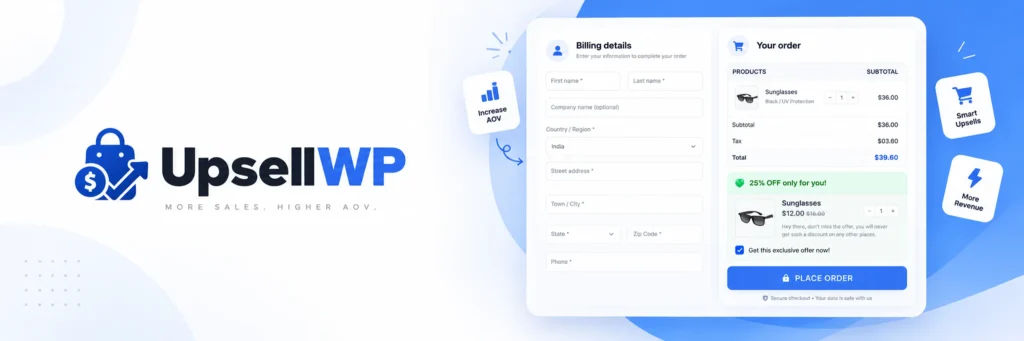
UpsellWP focuses only on upsell and cross-sell offers, rather than trying to be a full funnel builder. This keeps its interface simpler than CartFlows or FunnelKit. The free version, available on WordPress.org, includes real, usable features: checkout order bumps, cart recommendations, and Frequently Bought Together suggestions are all included before you pay anything.
Key features:
- Checkout order bumps (free plan).
- Cart recommendations (free plan).
- Frequently Bought Together suggestions (free plan).
- Post-purchase offers (Pro plan).
- A/B testing (Pro plan).
- Advanced conditional targeting (Pro plan).
Pros:
- The free plan covers checkout and cart recommendations with no trial period.
- Simpler interface than the larger funnel-builder plugins.
- A low-risk way to test whether recommendations work before you pay.
Cons:
- Post-purchase offers, A/B testing, and advanced targeting need the Pro plan.
- Does not offer a full checkout redesign the way CartFlows does.
- Overall feature set is smaller than the bigger funnel platforms.
Pricing: Free version available on WordPress.org. Pro plans start from around $69 per year.
Final verdict: UpsellWP is a good place to start if you are not yet sure whether product recommendations are worth the investment for your store. The free plan gives you enough to find out, before you spend any money.
7. CartFlows — WooCommerce Checkout Builder with Recommendation Offers
CartFlows works well for stores where the real problem is checkout conversion, not just missing recommendation offers. If you want to rebuild your checkout completely, instead of adding recommendations to the one you already have, this plugin is built for that.
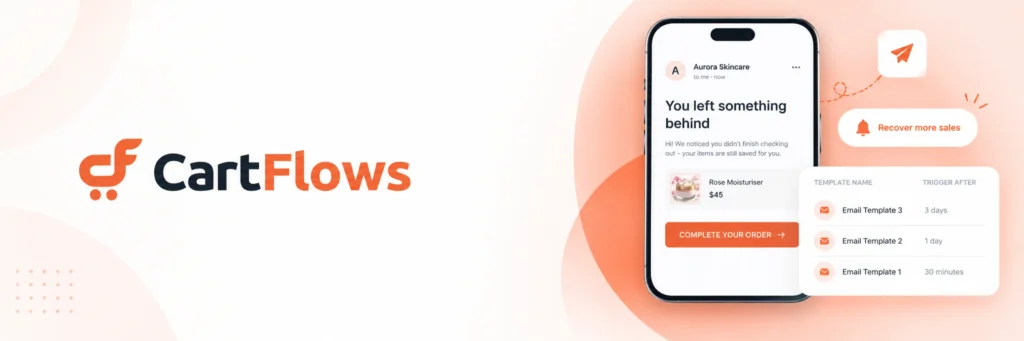
CartFlows does not just add recommendation offers to your current checkout. It replaces the checkout entirely. Using a page builder like Elementor, you build a new checkout flow, either multi-step or single page. Order bumps, one-click upsells, and downsells are built into this new flow, instead of being added on top of the default WooCommerce pages.
This is a bigger project than simply installing a plugin and turning on a widget. But it makes sense for a store where checkout itself is the weak point, since a rebuilt, better-tested checkout can improve overall sales, not just the value of each order.
Key features:
- Visual, drag-and-drop checkout and funnel builder.
- Checkout templates designed for higher conversion.
- Checkout order bumps.
- One-click post-purchase upsells and downsells.
- A/B testing on higher-priced plans.
Pros:
- Rebuilds checkout to improve overall conversion, not just order value.
- The visual builder makes it easy to see and change your funnel.
- Free version and lifetime license options are both available.
Cons:
- A bigger setup project than a plugin built around one simple offer widget.
- More than you need if your checkout already converts well.
- No dedicated product-page recommendation feature.
Pricing: A free version is available. Paid plans and lifetime licenses exist, but prices have changed with recent updates, so check CartFlows’ own pricing page directly.
Final verdict: CartFlows is worth it for stores where the checkout itself needs work. If your checkout already converts well and you just want to add recommendations to it, a smaller, simpler plugin will get you there faster.
Detailed Feature Comparison Table
| Plugin | Product Page Recommendations | Cart Recommendations | Checkout Recommendations | Post-Purchase Offers | Rule-Based Targeting | Free Version | Starting Price |
|---|---|---|---|---|---|---|---|
| PickPair | ✅ | ✅ | ✅ | ✅ | ✅ | ✅ | Free plan available |
| WooCommerce Product Recommendations | ✅ | ✅ | ✅ | ❌ | ❌ | ❌ | Check WooCommerce.com |
| YITH Frequently Bought Together | ✅ | ❌ | ❌ | ❌ | ❌ | ✅ | Check official site |
| Personalized Recommendations | ❌ | ✅ | ✅ | ✅ | ✅(Advanced) | ❌ | $149/yr |
| FunnelKit | ❌ | ❌ | ✅ | ✅ | ✅ | ✅ | $99.50/yr |
| UpsellWP | ✅ | ✅ | ✅ | ✅(Pro) | ✅(Pro) | ✅ | $69/yr |
| CartFlows | ❌ | ❌ | ✅ | ✅ | ❌ | ✅ | Check official site |
Best Plugins by Use Case
Here is a quick summary of which WooCommerce product recommendation plugin is best for each type of need, based on the full reviews above.
Best overall WooCommerce product recommendation plugin: PickPair. It covers product page, cart, checkout, and post-purchase recommendations from one plugin, with shared rules and reports.
Best official extension: WooCommerce Product Recommendations. Built and maintained directly by the WooCommerce.com team.
Best for simple product-page bundles: YITH WooCommerce Frequently Bought Together. A simple, focused tool with nothing extra to set up.
Best for advanced targeting: Personalized Recommendations by StoreApps. It is the only plugin here with true offer sequencing and AND/OR rule logic.
Best for email marketing and order bumps: FunnelKit. It combines checkout recommendations with a full CRM and automation system.
Best free WooCommerce product recommendation plugin: UpsellWP. Its free plan is genuinely useful, covering checkout bumps, cart recommendations, and Frequently Bought Together offers.
Best for rebuilding checkout: CartFlows. It replaces the default WooCommerce checkout with a custom, conversion-focused flow.
How to Choose the Right WooCommerce Product Recommendation Plugin
Choosing the right plugin starts with understanding where recommendations would actually help your customers, and how much of the buying journey you want one plugin to cover. Here are the main things to think about.
Best WooCommerce Product Recommendation Plugin for Full Coverage If you want product page, cart, checkout, and post-purchase recommendations all from one plugin, PickPair is built for exactly that. It saves you from managing separate settings, reports, and renewal dates across several different plugins.
Best WooCommerce Product Recommendation Plugin for Beginners If you have never used a recommendation feature before, choose a plugin with a genuinely useful free plan over one with the longest feature list. UpsellWP and PickPair both let you get a working recommendation live without building a full sales funnel first.
Best Free WooCommerce Product Recommendation Plugin UpsellWP’s free plan is the strongest option in 2026. It covers checkout order bumps, cart recommendations, and Frequently Bought Together suggestions, with no forced upgrade for basic use. PickPair’s free plan also covers several recommendation types.
Other things to think about:
- Do you want an official, first-party extension? WooCommerce Product Recommendations is built and maintained directly by WooCommerce.com.
- Do you run complex, conditional promotions? Personalized Recommendations by StoreApps has the deepest rules engine, useful for BOGO deals, sequenced offers, and cart-value based pricing.
- Do you only need product page bundles? YITH Frequently Bought Together is the most focused option, with nothing extra to set up.
- Is checkout conversion your real problem? CartFlows rebuilds the checkout itself, instead of just adding recommendations to it.
- Are you already using email marketing automation? FunnelKit combines recommendations with a built-in CRM and abandoned cart recovery.
Integrations worth checking:
- Payment gateways (Stripe, PayPal, and any regional gateway you use).
- Compatibility with WooCommerce Cart and Checkout Blocks.
- Analytics or reporting, whether built into the plugin or exported elsewhere.
- Email marketing platform, if the plugin does not include automation on its own.
Thinking about growth: if you plan to run seasonal promotions, subscription upgrades, or sequenced recommendations as your store grows, Personalized Recommendations and PickPair both handle this kind of complex logic better than a smaller, single-purpose plugin.
How to Add Product Recommendations to WooCommerce (Without Code)
If this is your first time setting one up, the general steps for how to add product recommendations in WooCommerce are similar across most plugins on this list.
- Install and activate your chosen WooCommerce product recommendation plugin from the WordPress admin area.
- Choose whether you want automatic recommendations (based on order history) or to hand-pick which products should be recommended together.
- Choose where the recommendation should appear: the product page, cart, checkout, or post-purchase page.
- Set any targeting rules, for example by category, cart total, or customer type, so the recommendation only shows to relevant visitors.
- Place a real test order to confirm the recommendation shows correctly and any discount applies as expected.
- Check the plugin’s built-in reports after a week or two to see whether the recommendation is actually converting before you add more.
None of the plugins in this guide need coding knowledge to set up. Whether you are creating your first product-page recommendation or a full checkout suggestion, the main difference between plugins is how much setup they ask for. A simple plugin like UpsellWP can take just a few minutes. A funnel-based tool like CartFlows needs more time, since you are building a full checkout flow first.
Why PickPair Is a Strong Choice
PickPair earns the top spot for a few clear reasons.
Covers the whole customer journey from one plugin. Most recommendation plugins focus on just one part of the journey, the product page, checkout, or post-purchase, and stop there. PickPair covers all of them: Frequently Bought Together bundles, cart recommendations, checkout order bumps, an add-to-cart pop-up, and post-purchase Thank You page offers, all from one dashboard.
Uses rules, not random suggestions. Offers can be limited by product, category, cart total, customer type, login status, or past orders. This means a first-time visitor and a returning customer do not have to see the exact same recommendation.
Gives you manual control, not just automatic logic. You can choose exactly which products should be recommended together, instead of relying only on order-history-based guesswork that can misfire on a smaller catalog.
Has built-in reports. Every recommendation tracks its own views, clicks, and revenue inside the plugin. You do not need a separate analytics tool to see what is actually working.
Works with the newer checkout blocks. It supports both the classic WooCommerce checkout and the newer Cart and Checkout Blocks, which matters more and more as new stores adopt the block-based setup.
Helps bring customers back. The automatic next-order coupon is aimed at getting a second purchase from the same customer, a feature most recommendation plugins skip since they only focus on the current order.
Product Recommendation vs. Cross-Sell vs. Upsell: What’s the Difference
These words are often used interchangeably, which makes comparing plugins confusing. Here is the plain difference between them, with simple examples.
Product recommendation — a general term for any suggested product shown to a shopper, whether it’s a cross-sell, an upsell, or a “customers also bought” style suggestion.
Cross-sell — a specific type of recommendation suggesting a different but related product. Someone buying a backpack sees a recommendation for a rain cover or packing cubes.
Upsell — a specific type of recommendation offering a higher-value version of the item a customer already wants. Someone looking at a 40-liter backpack sees a recommendation for the 60-liter model.
Order bump — a small recommendation shown at checkout, added with one checkbox before payment. A $9 packing cube set offered while buying a $150 backpack.
Most of the plugins in this guide generate two or three of these at once. This is why the real differences between them come down to how the recommendation is chosen and where it appears, not which one lists the most features on its website.
Compatibility, Performance & Checkout Blocks
A product recommendation plugin sits directly on your product pages, cart, and sometimes checkout, so compatibility and performance matter more here than with most other plugin types.
Cart and Checkout Blocks. WooCommerce’s block-based Cart and Checkout pages are now the default for new stores. Some older plugins, built for the older, shortcode-based checkout, do not render recommendations correctly inside the block editor. Check this clearly before you buy, especially if your store was set up recently. PickPair and FunnelKit both confirm support for the block-based checkout.
Caching and page builders. Recommendation plugins that generate offers dynamically can sometimes clash with strong caching plugins or page builder templates. Test a live recommendation after installing it, rather than assuming it will work everywhere without checking.
Relevance over volume. A recommendation plugin that shows a random, unrelated product will get ignored, or worse, make the page look cluttered. Plugins with rule-based targeting or manual selection, like PickPair, help keep recommendations relevant to what’s already being viewed or purchased.
Free plan limits. Several plugins in this guide give you one recommendation type for free, and keep the more useful parts, targeting rules, extra offer types, reporting, for paid plans. Check exactly what the free plan includes before assuming it covers what you need.
Practical Tips Before You Install a Recommendation Plugin
Before adding any WooCommerce product recommendation plugin to your store, here are a few things worth keeping in mind to avoid common problems.
Back up your store first. Recommendation plugins connect directly to your product pages, cart, and sometimes checkout. A recent backup means you can undo any problem quickly if something conflicts with your theme or another plugin.
Start with one recommendation type. Do not turn on every recommendation type at once. Launch one product page bundle or one cart recommendation first, check the results for a couple of weeks, then add more.
Keep recommendations relevant. A recommendation that matches what’s already in the cart or being viewed tends to convert well. A random, unrelated suggestion gets ignored, or makes the page feel cluttered. A backpack shop recommending a rain cover will do better than a random discount on an unrelated product.
Choose manual selection for a smaller catalog. Automatic, order-history-based recommendations work best with a large volume of past orders. If your store is new or has a small catalog, hand-picking which products go together often works better at first.
Test the storefront after activating. View a real product page and place a test order to confirm the recommendation shows correctly, applies the right discount, and does not break the layout on both desktop and mobile.
Check the built-in reports. Most plugins in this guide track views, clicks, and revenue for each recommendation. Use this data to decide whether to keep, change, or remove an offer, instead of guessing.
Review results regularly. If click-through rates for a recommendation start dropping, try different products or placement before assuming the plugin itself is the problem.
Frequently Asked Questions
PickPair, WooCommerce Product Recommendations, and Personalized Recommendations are among the strongest options available, depending on whether you want full coverage across your store, an official extension, or advanced targeting.
PickPair is the strongest choice for covering product page, cart, checkout, and post-purchase recommendations from a single plugin, instead of needing several separate tools.
UpsellWP and PickPair are both easy to start with, since neither one needs you to build a visual sales funnel before your first recommendation goes live. CartFlows and FunnelKit both take more setup time, since they are built around funnel or checkout customization.
Only in a limited way. WooCommerce has a built-in “Related Products” section that shows other items from the same category, and a manual “Upsells” and “Cross-sells” field on each product. It does not support checkout recommendations, post-purchase offers, or targeting rules. For anything beyond basic related products, you need a plugin.
Automatic recommendations are generated from order history, showing what customers have actually bought together in the past. Manual recommendations are chosen by hand by the store owner. Automatic tends to work better with a large order history; manual tends to work better for a newer or smaller catalog.
Product-level recommendations work well right on the product page, as a “frequently bought together” box. Recommendations also fit naturally in the cart. Order bumps belong at checkout, as one simple checkbox. Post-purchase recommendations work best on the Thank You page, right after checkout.
UpsellWP’s free plan covers checkout order bumps, cart recommendations, and Frequently Bought Together suggestions, with no trial period. PickPair also offers a free plan that covers several types of recommendations.
It depends on the plugin and how many recommendation types you turn on at once. Well-built plugins only load extra code on pages where a recommendation is actually shown. Check your site speed after installing a plugin, and again after turning on each new recommendation type.
Choose PickPair if you want product page, cart, checkout, and post-purchase recommendations covered from one plugin, with a free plan, targeting rules, and reports built in. Choose WooCommerce Product Recommendations if you specifically want an official, first-party extension built directly by the WooCommerce.com team. Both are actively maintained. The real decision comes down to how much control and coverage you need versus sticking with an official tool.
Conclusion
The best WooCommerce product recommendation plugin for you comes down to two things: how much of the buying journey you want covered, and how much control you need over which products get recommended.
If you want full coverage from the product page all the way to post-purchase, PickPair is the strongest all-around choice. If you specifically want an official WooCommerce.com extension, WooCommerce Product Recommendations is built directly by that team. If you only need simple product-page bundles, YITH WooCommerce Frequently Bought Together does that one job well. If your promotions need real conditional logic, Personalized Recommendations by StoreApps goes deeper than any other plugin here. If email marketing automation is part of your plan, FunnelKit combines that with checkout recommendations. If you are testing the idea for the first time, UpsellWP’s free plan is the lowest-risk place to start. And if your checkout itself needs rebuilding, CartFlows is built for that job.
My overall advice:
- Want everything from one plugin? Choose PickPair.
- Want an official WooCommerce.com extension? Choose WooCommerce Product Recommendations.
- Only need product page bundles? Choose YITH WooCommerce Frequently Bought Together.
- Running complex, conditional promotions? Choose Personalized Recommendations by StoreApps.
- Need email automation too? Choose FunnelKit.
- Testing recommendations for the first time? Choose UpsellWP.
- Is checkout conversion your real problem? Choose CartFlows.
Whichever plugin you choose, start with one recommendation type, check the built-in reports for a few weeks, then add more. Product recommendations work best when they feel specific and useful to what a customer is already looking at, not when every page of your store is covered in suggestions.
Ready to show relevant recommendations on the product page, cart, checkout, and post-purchase, all from one dashboard? Install PickPair and set up your first recommendation directly from your WooCommerce admin area.